News
Negotiation & Mediation in Debt Recovery Planning: Legal Framework & Practical Considerations
19 July 2026
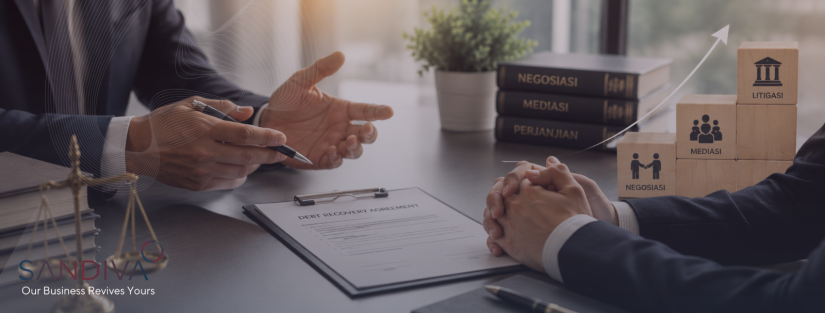
This client alert summarizes the role of negotiation and mediation as initial measures in debt recovery and highlights the relevant legal framework (UU 30/1999, Article 1338 of the KUHPerdata, and PERMA 1/2016), as well as their practical implications for both creditors and debtors.
In debt recovery practice, negotiation and mediation are often used as efficient preliminary measures before litigation. Their legal framework is governed, among others, by UU 30/1999 (Alternative Dispute Resolution), Article 1338 of the KUHPerdata (binding force of agreements), and PERMA 1/2016 concerning mediation in court proceedings.
- Negotiation is conducted directly between the creditor and debtor, while mediation involves a neutral third party facilitating the parties in reaching a settlement.
- Alternative Dispute Resolution ("ADR"), including negotiation and mediation, constitutes a dispute resolution mechanism outside the court through procedures agreed upon by the parties under UU 30/1999.
- Agreements resulting from negotiation or mediation should be documented in writing so that they become binding upon the parties as a contract pursuant to Article 1338 of the KUHPerdata.
- If a dispute proceeds to court, court-annexed mediation is, in principle, mandatory before examination of the merits of the case in accordance with PERMA 1/2016, subject to certain exceptions.
- Potential risks should nevertheless be considered, including an uncooperative debtor, differing expectations between the parties, or lack of confidence in the mediator.
For a more comprehensive discussion and its practical implications, please refer to the client alert below or contact our team.
Background
A business transaction directly gives rise to rights and obligations for the parties involved in such transaction. One party is obligated to provide goods and/or services, while the other party is obligated to make payment for such goods and/or services. In practice, it is not uncommon for goods and/or services to have been delivered or performed while the other party has not fulfilled its payment obligation.
This situation results in bad debt and represents one of the risks that is almost unavoidable. When such circumstances occur, namely when receivables become delinquent or a debtor fails to fulfill its payment obligations, parties are faced with the choice of undertaking debt recovery efforts. Should they proceed directly with litigation, or should they first pursue negotiation and/or mediation as an initial step in debt recovery?
Therefore, it is important for companies and parties engaged in business transactions to understand debt recovery planning in order to determine which course of action should be taken and which option would be the most beneficial in recovering outstanding receivables.
1. Debt Recovery Planning
a. Definition of Debt Recovery Planning
Debt recovery planning, or in Bahasa Indonesia rencana pemulihan utang, may be defined as a plan developed by a creditor or a party entitled to payment to ensure that receivables can be recovered effectively. Nevertheless, such planning must comply with applicable laws and regulations and remain within legal boundaries. In general, debt recovery planning does not necessarily involve immediately pursuing litigation as the primary method of recovering receivables. Mediation and negotiation may serve as initial measures that can be undertaken in debt recovery efforts.
b. Negotiation and Mediation
The fundamental distinction between negotiation and mediation lies in the parties involved. Negotiation is conducted solely between the parties involved (the debtor and creditor) to determine a solution, whereas mediation is conducted not only by the parties but also with the involvement of a mediator acting as a neutral intermediary to assist in resolving the payment dispute.
2. Brief Legal Framework
In addition, negotiation and mediation constitute forms of alternative dispute resolution. Pursuant to Article 1 point 10 of Undang-Undang Nomor 30 Tahun 1999 tentang Arbitrase dan Alternatif Penyelesaian Sengketa ("UU 30/1999"), it is stipulated as follows:
“Alternative dispute resolution is an institution for the settlement of disputes or differences of opinion through procedures agreed upon by the parties, namely settlement outside the Court by means of consultation, negotiation, mediation, conciliation, or expert appraisal.”
Unlike litigation, which directly involves filing a lawsuit and fully submitting the matter to the Court for a judgment ordering the debtor to make payment to the creditor, negotiation and mediation within debt recovery planning may serve as more effective initial measures than immediately commencing litigation proceedings.
3. Key Practical Considerations
Negotiation & Mediation as Initial Debt Recovery Measures
Choosing negotiation and mediation as initial debt recovery measures offers several advantages that may be considered by business actors when dealing with delinquent debtor payments.
- Expedited process and lower costs (as they do not require lengthy court examination proceedings, resulting in lower overall costs).
- Flexibility (the outcome of negotiation and mediation is more flexible, allowing the parties to agree on restructuring arrangements, payment rescheduling, or interest reductions).
- Preservation of business relationships (the business relationship between creditor and debtor may remain intact because the objective of negotiation and mediation is to achieve a win-win solution, ensuring that neither party feels pressured).
- Reduction of conflict escalation (litigation often gives rise to further legal actions pursued by parties who are dissatisfied with the judgment, causing disputes to escalate and become prolonged).
In addition to the foregoing, the outcome of negotiation and mediation may be documented in the form of an agreement and further formalized through a notarial deed. Referring to Article 1338 of the Kitab Undang-Undang Hukum Perdata ("KUHPerdata"), which provides:
“All agreements legally entered into shall bind the parties thereto as law. Such agreements may not be revoked other than by mutual agreement of the parties or on grounds prescribed by law. Agreements shall be performed in good faith.”
Accordingly, negotiation and mediation not only offer various benefits and advantages, but the outcome of negotiation and mediation also constitutes a legally binding agreement upon the parties.
Under Indonesian civil law, mediation is generally regarded as an important manifestation of the parties' good faith in resolving disputes. This principle is reflected in Peraturan Mahkamah Agung Nomor 1 Tahun 2016 tentang Prosedur Mediasi di Pengadilan ("Perma 1/2016"), which in principle requires mediation in certain civil cases before the examination of the merits of the case, provided that the matter does not fall within the exceptions stipulated under Perma 1/2016.
In this regard, negotiation and mediation are viewed as important mechanisms and may be considered effective initial measures within a debt recovery plan. Negotiation and mediation at the early stage of debt recovery planning may serve as benchmarks and primary considerations for companies or specific parties in determining the next course of action for debt recovery.
4. Practical Implications & Recommendations
- Document the outcome of negotiation and/or mediation in writing (for example, through an addendum, debt restructuring agreement, or notarial deed) so that it becomes binding upon the parties as a contractual agreement.
- Utilize negotiation and/or mediation as an initial measure prior to litigation in order to save time and costs while preserving business relationships, provided that the parties remain cooperative.
- If the dispute proceeds to court, anticipate the obligation to undergo court-annexed mediation pursuant to PERMA 1/2016, while paying attention to the applicable exceptions.
Nevertheless, there are weaknesses and challenges in the implementation of negotiation and mediation. Examples include a debtor who is uncooperative or refuses to participate in negotiations, expectations between the creditor and debtor that are too far apart, lack of trust in the mediator, or even the absence of any response from the debtor. Therefore, it is important for companies and creditors to understand negotiation and mediation as initial measures and to obtain professional assistance in developing a debt recovery planning strategy. In doing so, the course of action taken is more likely to be appropriate and effective in recovering receivables.